
Core Thesis
For decades, software engineering productivity was constrained by the cost of writing and maintaining code. Generative AI reduces that constraint.
As implementation becomes cheaper, the bottleneck does not disappear—it shifts upward. The limiting factor becomes system design, domain modeling, and the ability to maintain coherence as code production accelerates.
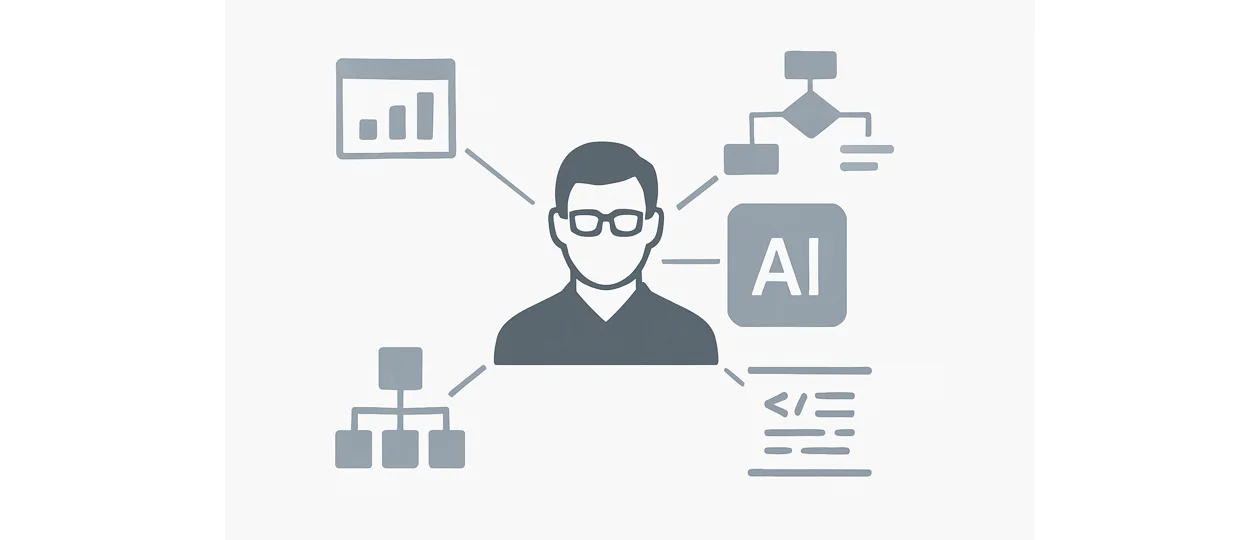
This shift favors engineers who can think in systems, not just produce code.
The Old System
Software development was historically optimized around manual code production.
- Engineers wrote most implementation by hand
- Boilerplate and integration code consumed significant time
- Debugging and maintenance dominated ongoing work
- Infrastructure required constant configuration and upkeep
This created a clear constraint: engineering output was limited by how much reliable code teams could produce and maintain.
Over time, the profession adapted to this environment. Engineers became highly skilled at navigating codebases, frameworks, and tooling ecosystems—often focusing more on managing complexity than shaping the underlying problem.
What AI Changes
AI coding systems compress the cost of implementation.
They can generate scaffolding, tests, documentation, and refactors, reducing the time required to move from idea to working code.
The result is not just faster development—it is increased throughput. More code is produced, more quickly, with less effort.
Implementation becomes partially automated infrastructure rather than purely manual work.
The New Constraint
As code production accelerates, systems accumulate complexity faster than before.
The constraint shifts from writing code to ensuring that code behaves coherently as a system.
The difficult problems are no longer local:
- Defining clear system boundaries
- Designing stable abstractions
- Managing data flow and state
- Preventing unintended coupling
- Anticipating failure modes
These are coordination problems, not implementation problems.
They cannot be automated away. They require judgment shaped by experience with real systems.
Implications for Engineers
This shift changes where engineering leverage comes from.
Experience compounds differently
Time spent working on production systems builds intuition about failure, scaling, and complexity—now the primary constraints.
Implementation skill is less differentiating
AI reduces the advantage of engineers whose leverage was primarily code production speed.
Leverage moves up the stack
High-impact engineers focus on:
- System design and architecture
- Interface and boundary definition
- Problem decomposition
- Validation and observability
The role shifts from writing code to shaping how systems behave.
System Insight
When a constraint is removed, the system does not simplify—it rebalances.
In software engineering, AI reduces the cost of producing code but increases the rate at which complexity enters the system.
The new bottleneck is not thinking in the abstract. It is maintaining system coherence under conditions of accelerated output.
This is why experienced engineers become more valuable, not less. Their role shifts from producing code to ensuring that an abundance of code forms a system that actually works.