
Core Thesis
AI compresses the cost of writing code. Enterprise systems, however, were never constrained by code production alone. As that constraint weakens, the bottleneck shifts upward—into validation, coordination, and release.
The limiting factor is no longer building software. It is moving software into production safely and repeatedly.
The Old System
Software delivery was historically bounded by engineering throughput.
- Code was written manually
- Specialized knowledge created scarcity
- Iteration cycles were slow
Organizations optimized for this constraint:
- Hiring and scaling engineering teams
- Investing in developer tools and abstractions
- Reducing implementation complexity
Delivery inefficiencies were tolerated because they were not binding. Code production was.
What Changed
AI changes the production function of software.
- Code generation becomes fast and inexpensive
- Iteration cycles compress dramatically
- The marginal cost of additional code approaches zero
But delivery systems do not scale with this shift.
- CI pipelines remain time-bound
- Test systems remain brittle or slow
- Approvals remain human-gated
- Integration remains complex
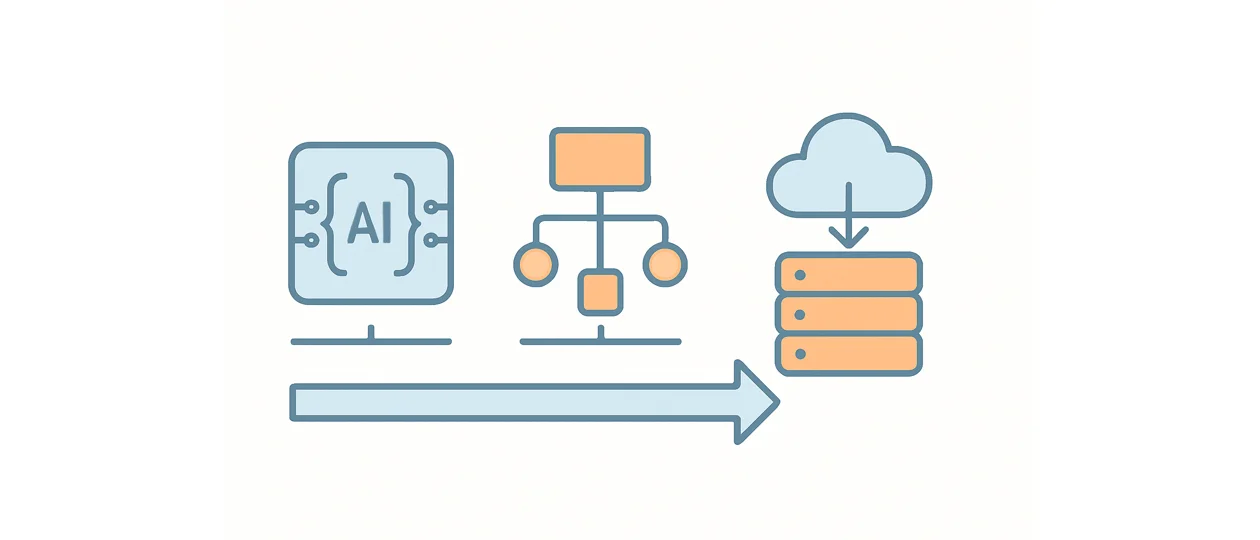
Code production accelerates. Delivery does not. The constraint moves.
The New Constraint
The bottleneck becomes software delivery throughput.
Validation
- Test speed and reliability gate iteration
- Integration testing dominates timelines
- More code increases validation load
Integration
- Service dependencies create coordination overhead
- Shared environments introduce contention
- Reproducibility becomes difficult
Coordination
- Cross-team dependencies slow progress
- Approval layers introduce queues
- Organizational structure limits parallelism
Release
- Deployment remains a risk event
- Monitoring and rollback require judgment
- Stability constraints cap velocity
Generating changes is easy. Shipping them is not.
Implications
Shift from coding speed to system throughput
The highest leverage investment moves to:
- Fast, deterministic testing
- Reproducible, isolated environments
- Automated validation and policy enforcement
- Continuous delivery with small batch sizes
Delivery infrastructure becomes the system
CI/CD is no longer support—it is the production system.
- Pipelines define throughput
- Test orchestration defines speed
- Observability closes the delivery loop
The “factory” is the delivery pipeline, not the codebase.
Engineering work rebalances
- Less time writing code
- More time managing dependencies and failure modes
- Platform and infrastructure roles become central
The scarce skill shifts from implementation to system design.
Organization becomes part of the constraint
- Team boundaries define deployment boundaries
- Centralized approvals create bottlenecks
- Coupling between teams limits velocity
System architecture and org design converge.
System Insight
Constraints do not disappear—they relocate.
AI removes code production as the primary bottleneck, exposing delivery as the governing constraint. In enterprise systems, throughput is set not by how fast code is written, but by how fast it can be validated, coordinated, and safely deployed.
The advantage shifts to organizations that treat delivery as a system to be engineered.
Velocity is no longer a function of code generation. It is a function of how efficiently the system absorbs change.