
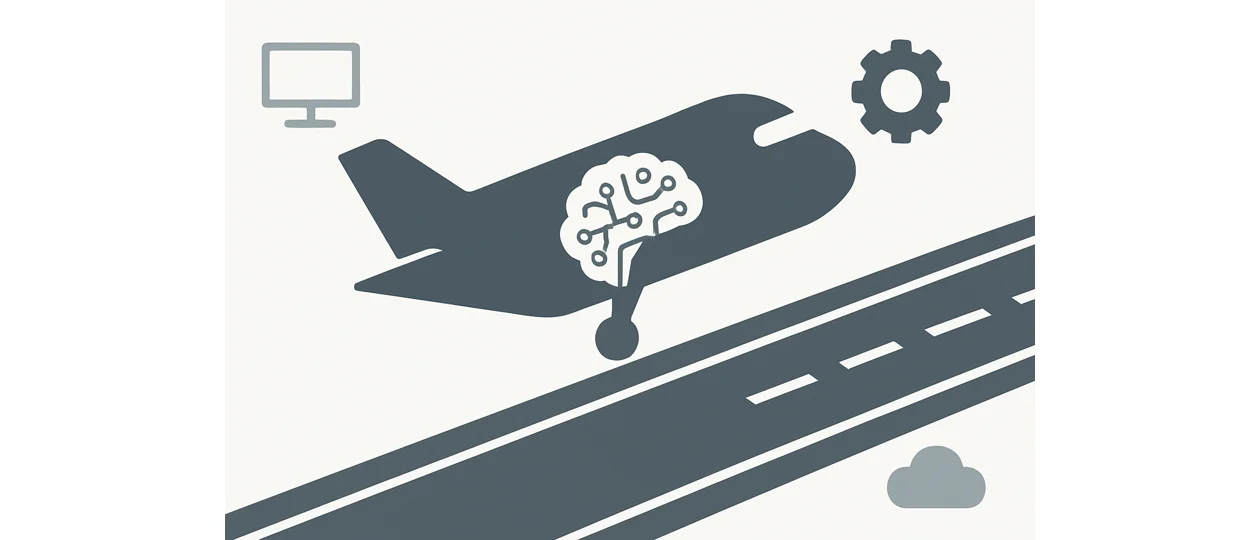
The dominant narrative around AI progress is still centered on model capability. Larger models, better benchmarks, more reasoning ability. The assumption is that once intelligence crosses a threshold, adoption naturally follows.
This framing is incomplete.
AI systems do not fail in the air. They fail on the ground. What determines whether AI compounds inside an organization is not just model quality, but whether the surrounding system allows that capability to translate into throughput. In practice, AI adoption is gated by something much more mundane: the condition of the runway.
The real question is not how powerful the model is, but how quickly an organization can clear the constraints that prevent that power from turning into work.
The Constraint Is Not Intelligence — It Is Throughput
Across most enterprises, AI does not encounter a capability ceiling. It encounters a systems ceiling.
The constraint is not whether the model can generate output. It is whether the organization can absorb, validate, route, and deploy that output fast enough to matter.
As explored in Tokens Are the New Throughput: Why Commits No Longer Measure Work, work is no longer measured by human-authored units. It is measured by how much machine-generated output can flow through the system and become production reality.
This reframes the problem entirely. AI is not a feature layer. It is a throughput amplifier. And like any amplifier, it exposes bottlenecks rather than removing them.
The Runway Is Where Systems Fail
The “runway” is the set of constraints that sit between generated output and realized value. These constraints are rarely visible in traditional engineering narratives because they were tolerable in a human-limited world.
Under AI, they become dominant.
Tech debt accumulates as friction in integration. AI-generated output cannot easily land in systems that are brittle, poorly abstracted, or tightly coupled. The cost of change remains high, regardless of how cheaply code can be produced.
Large teams introduce coordination overhead that scales non-linearly. In a world where output generation is cheap, alignment—not effort—becomes the scarce resource. As discussed in Why Small Teams Will Move Faster in the AI Era, smaller teams are structurally better aligned with AI-driven workflows.
Delivery bottlenecks become the primary limiter of value realization. Even if AI can generate code, decisions still queue: reviews, approvals, testing, compliance. As outlined in The Next Bottleneck: Enterprise Software Delivery, the system slows not at creation, but at release.
Token limits introduce a hard ceiling on context. AI systems are bounded by how much state they can hold and reason over at once. This is not just a technical constraint—it shapes how problems must be decomposed and how systems are architected.
People misalignment is the most persistent constraint. Organizations optimized for human productivity struggle to reorient around machine-accelerated workflows. Incentives, metrics, and mental models lag behind the underlying capability shift.
These are not edge cases. They are the default operating conditions of most enterprises.
Why These Constraints Exist
These constraints are not accidental. They are artifacts of the previous regime.
Enterprise systems were built for a world where human effort was the bottleneck. Coordination structures, review processes, and organizational design all evolved to manage scarce, expensive human output.
AI inverts this.
Output is now abundant. The system, however, is still optimized for scarcity. This mismatch is what creates the runway problem.
As argued in Agile Solved the Wrong Uncertainty, many modern processes were designed to manage uncertainty in human execution. They are poorly suited for a world where execution is cheap and instantaneous.
Even token limits reflect this transition. They are a reminder that while generation is cheap, context is still scarce. The system must be redesigned around this new constraint.
The Pace of Constraint Removal Determines Outcomes
The difference between organizations that successfully adopt AI and those that stall is not access to models. It is the rate at which they remove runway constraints.
This becomes a timing problem.
If the organization can reduce friction—simplify architecture, shrink teams, streamline delivery pipelines, realign incentives—faster than AI capability improves, then throughput compounds. The system begins to absorb and deploy AI-generated output at increasing speed.
If not, the opposite happens. AI capability increases, but realized value plateaus. The organization experiences what looks like diminishing returns, when in reality it is hitting a systems ceiling.
This explains why many early AI initiatives feel underwhelming. The model works. The system does not.
The System That Emerges
When the runway is clear, a different kind of organization begins to take shape.
Workflows become continuous rather than staged. Generation, validation, and deployment compress into tighter loops. Teams become smaller and more autonomous, because alignment is easier to maintain than coordination at scale.
Metrics shift from effort-based measures (commits, hours) to flow-based measures (tokens processed, cycle time, deployment frequency). Throughput, not activity, becomes the unit of progress.
Most importantly, the boundary between thinking and building starts to collapse. AI systems blur the line between design and execution, which means the infrastructure around them must support rapid iteration rather than controlled release.
Implications for Builders and Organizations
The practical implication is straightforward but non-trivial: investing in AI capability without investing in runway clearance is structurally inefficient.
Organizations need to treat constraint removal as a first-class engineering problem.
- Reducing tech debt becomes throughput optimization.
- Designing teams becomes a problem of alignment, not scale.
- Delivery pipelines must minimize queuing and decision latency.
- Systems must be architected with context limits in mind.
- Incentives must reward flow rather than effort. These are not incremental improvements. They are systemic changes.
Conclusion: AI Does Not Fail in the Air
AI will take off. The question is where.
Not every organization will see the same outcome, even with access to identical models. The differentiator will not be intelligence—it will be infrastructure.
The runway is the system.
And in this phase of the AI cycle, the winners will not be those with the most powerful models, but those who clear constraints the fastest.